

What does Magnifica Humanitas have to do with me? (Part 1)
Pope Leo’s distinction between man and AI seems to call us toward something higher

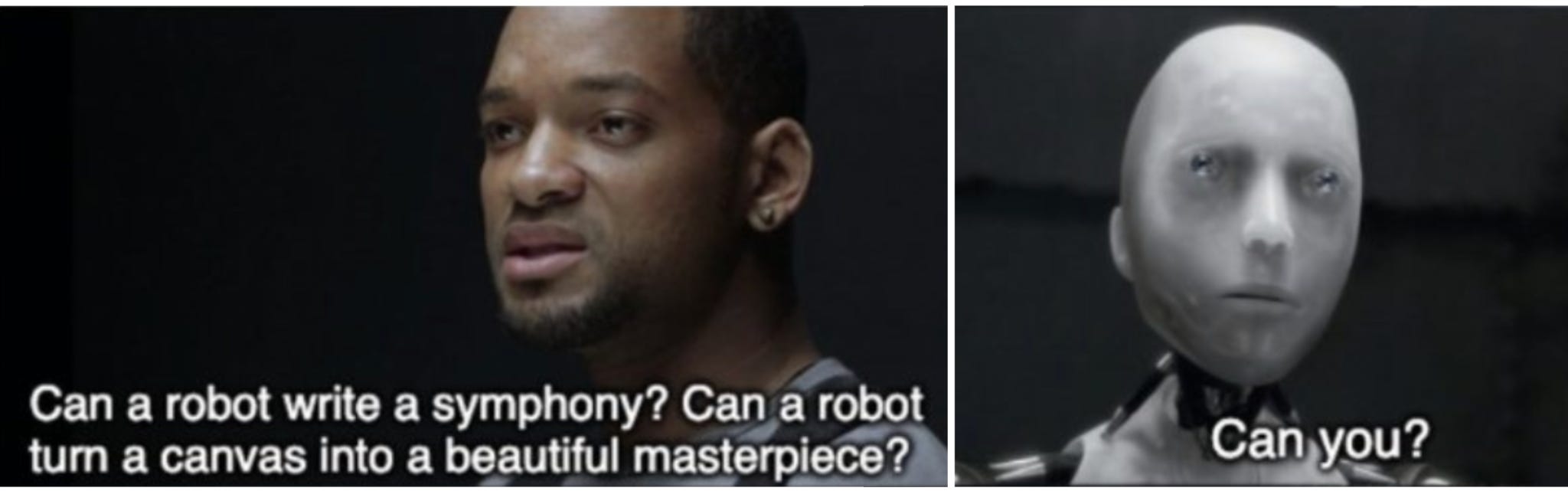
The internet has been abuzz with the recent publication of Pope Leo XIV’s encyclical Magnifica Humanitas, or Magnificent Humanity. Just over a year ago, when he was elected, Pope Leo XIV explained that he cared deeply about the transformations that new technologies like AI are bringing about in the workforce and in how we think about humanity. This new encyclical seeks to begin addressing those concerns and providing guidance on the way forward.
As someone who isn’t very involved in tech policy, I wondered if it would contain anything valuable for me personally. I was pleasantly surprised. The encyclical is a rich treasure trove of reflection that each person — regardless of religion — can find deep meaning and inspiration. The first profoundly personal takeaway is the distinction between man and machine.
Pictured above is a famous scene from the film I, Robot. Detective Del Spooner (portrayed by actor Will Smith) is questioning Sonny, a robot suspected of possessing human-like consciousness. Skeptical that a machine could ever be truly comparable to a person, Spooner asks whether a robot can write a symphony or create a great work of art. Sonny responds with a simple question of his own: “Can you?”
The exchange exposes a weakness in Spooner’s reasoning and raises a deeper question about what qualities truly distinguish persons from machines.
I must admit I had a similar feeling while reading sections of Magnifica Humanitas, particularly Paragraph 99:
“So-called artificial intelligences do not undergo experiences, do not possess a body, do not feel joy or pain, do not mature through relationships, and do not know from within what love, work, friendship, and responsibility mean. Nor do they have a moral conscience, since they do not judge good and evil, grasp the ultimate meaning of situations, or bear responsibility for consequences. They may imitate language, behavior, and analytics skills, or even simulate empathy and understanding, but they do not understand what they produce, for they lack the effective, relational, and spiritual perspective through which human beings grow in wisdom. Even when these tools are described as capable of “learning,” their way of doing so is different from that of a human person. It is not the experience of those who allow themselves to be shaped by life and grow over time through choices, mistakes, forgiveness and fidelity. Rather, it is a form of statistical adaptation based on data and feedback, which can be very effective, but does not imply inner growth.”
As I read this, it occurred to me that human beings frequently fall short of the Pope’s portrayal. In a sense, we are not always fully dedicated to being human.
We certainly have the capacity to be beings distinct from machines, as Pope Leo XIV claims, but more often we “call evil good and good evil” (Isaiah 5:20) or—perhaps even worse—say that truth is relative and subjective, and therefore nothing can be labeled either one. In fact, according to the Pew Research Center, fewer than half of U.S. adults say “there are clear and absolute standards by which to decide whether something is right or wrong.”
We reject empathy and claim that it’s every man for himself, or outsource our responsibility for love of neighbor to the government, leaving half of Americans reporting lonely, left out, and lacking companionship. We hold grudges that split families apart. About 27% of Americans report estrangement from at least one family member, and most say it lasts more than a year. We ignore our relationship to God and pursue a purely self-interested construction of our lives.
“The ability to care for one another is a fundamental dimension of our humanity,” Pope Leo XIV writes, “one that is learned and mastered through lived experience. Reading stories to a child, offering company to an elderly person and arranging a home so that it is welcoming are simple gestures often rooted in family life. They teach us to value care at a societal level and train us to recognize others as persons worthy of our attention.”
But increasingly, we do not know, let alone care, for our neighbors. In 2023, the U.S. surgeon general declared loneliness a national epidemic. It seems we are abandoning this fundamental dimension of what it means to be human.
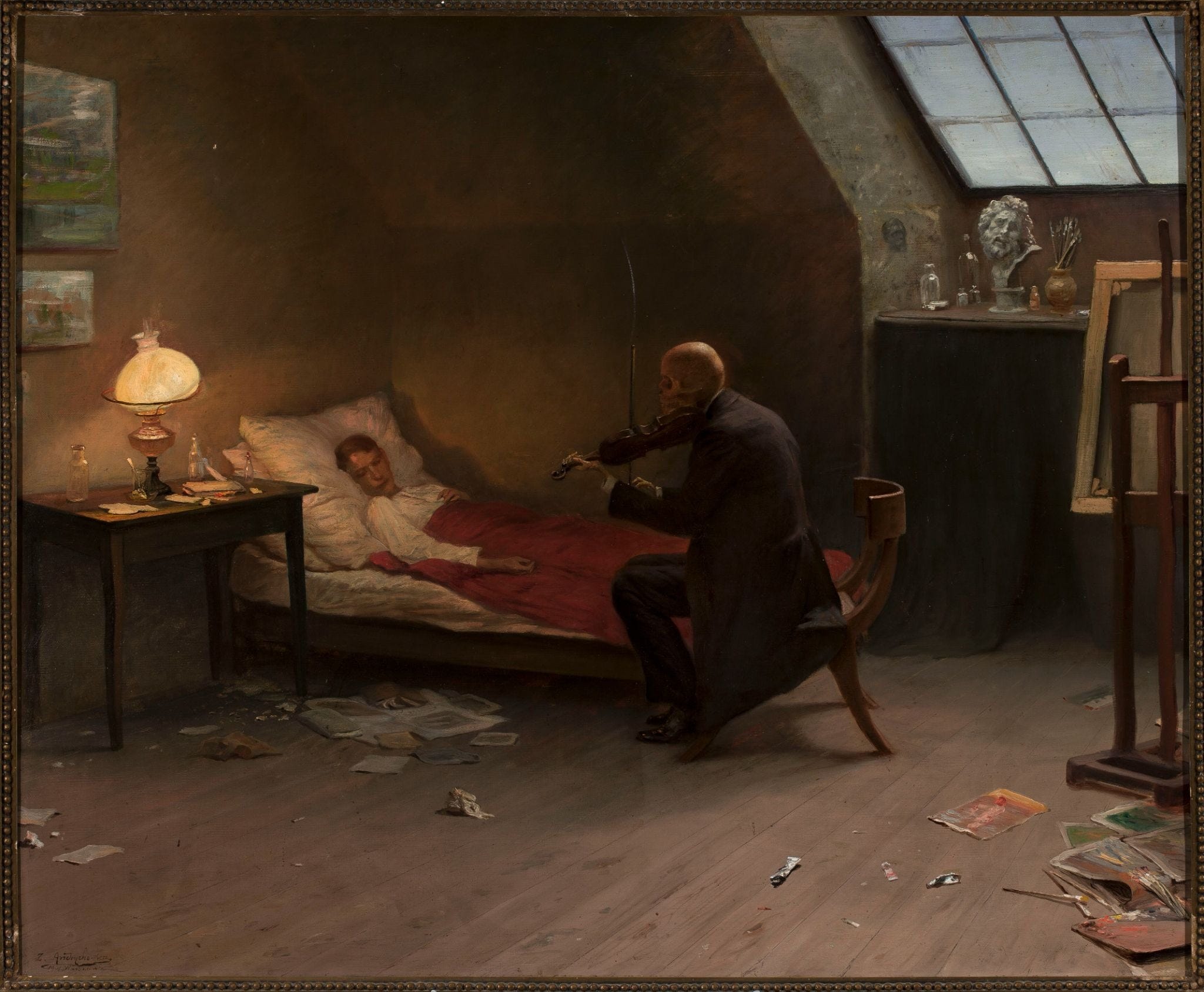
The questions posed in I, Robot are no longer the wall between man and machine they once were. Artificial intelligence can compose music. It can create visual art. It can even write (so well that it has fooled literary contests). All we have left to distinguish ourselves and preserve our dignity are a dedication to caring for those around us and to living purposefully.
What will we be if we let go of even those?
Pope Leo XIV warns against sensitive decisions “being fully delegated to automated systems that do not know ‘compassion, mercy, forgiveness, and above all, the hope that people are able to change.’” He claims that artificial intelligence cannot act in accordance with these principles. I can easily imagine one of the large language models asking the same question posed in I, Robot: Can you?
It is imperative that we work toward being able to say with certainty, “Yes.”
It is not a guarantee. We can choose the hard work of pursuing humanity, or we can resign to the more base and animalistic tendencies within us. If we choose the latter, our world will face dire consequences. But if we choose the former, there is hope.
“Even when persons dehumanize themselves and bring about tragedy, a small light continues to shine within humanity,” writes Pope Leo XIV, “one that can be rekindled, with God’s grace, along paths of conversion and reconciliation. As Viktor Frankl rightly observed, in moments of horror, ‘we have come to know man as he really is. After all, man is that being who invented the gas chambers of Auschwitz; however, he is also that being who entered those gas chambers upright, with the Lord’s Prayer or the Shema Yisrael on his lips.’”
It seems, then, that the primary responsibility of each person in an increasingly technical world would be to rediscover and rededicate ourselves to being fully human. To seek an understanding of the ultimate meaning of things, to have empathy and understanding, to cultivate a spiritual perspective, to grow in wisdom, and to judge good and evil accordingly. As Pope Francis said, “We become fully human when we become more than human, when we let God bring us beyond ourselves in order to attain the fullest truth of our being.”
There is much more to unpack in the coming weeks. For now, I leave you with this:
How human are you willing to become?