

Please Stop Telling Me “The Voting Rights Act is Dead”
Why you should celebrate the Louisiana v. Callais decision (and why we still have work to do).

Last month, the Supreme Court decided Louisiana v. Callais. The decision has been getting some serious media attention, and from groups saying that it “gutted” the Voting Rights Act to celebrities claiming the law is dead altogether, I have grown weary.
Because that isn’t what happened. To lament so drastically is to ignore how far we have come as a nation, to misunderstand the Voting Rights Act (as well as the Court’s opinion), and to ignore what important work remains to be done.
I respectfully but outrightly reject Justice Kagan’s statement that this decision “renders Section 2 all but a dead letter,” because Section 2 of the Voting Rights Act was meant to stop states from denying citizens the ability to vote because of their race. In that regard, Section 2 still stands strong. Callais matters because it forces us to distinguish between protecting communities from discrimination and sorting voters by race.
NOTE: If you’re uninterested in the historical explanation (though I think it is important), skip to “Our communities are more than the color of our skin”
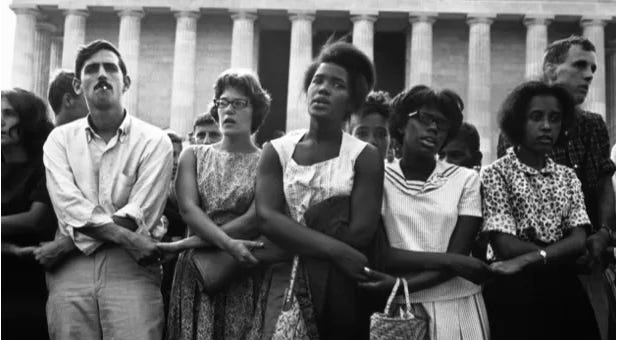
How did we end up here?
To understand this case, it’s important to first understand why states created Black districts in the first place. It traces back to the 15th Amendment and what happened in the years that followed.
The Fifteenth Amendment says:
“Section 1: The right of citizens of the United States to vote shall not be denied or abridged by the United States or by any State on account of race, color, or previous condition of servitude–
Section 2: The Congress shall have power to enforce this article by appropriate legislation.”
It’s fairly straightforward. Former slaves must be allowed to vote, and Congress can make laws that enforce that right. After the law was enacted in 1870, former slaves began voting. But by the 1890s, many states started taking actions to prevent those votes from being counted. There were literacy tests, poll taxes, grandfather clauses, white primaries, and other policies designed so that Black men and women would not be able to cast ballots.
Additional action was needed from Congress, and Section 2 of the Fifteenth Amendment empowered Congress to take that action: the Voting Rights Act of 1965 (extended in 1970, 1975, and 1982). This law “abolished all remaining deterrents to exercising the right to vote.”
For the purposes of understanding Louisiana v. Callais, only an explanation of Section 2 is necessary.
Section 2 of the Voting Rights Act reads:
“(a) No voting qualification or prerequisite to voting or standard, practice, or procedure shall be imposed or applied by any State or political subdivision in a manner which results in a denial or abridgement of the right of any citizen of the United States to vote on account of race or color, or in contravention of the guarantees set forth in section 4(f)(2), as provided in subsection (b).
(b) A violation of subsection (a) is established if, based on the totality of circumstances, it is shown that the political processes leading to nomination or election in the State or political subdivision are not equally open to participation by members of a class of citizens protected by subsection (a) in that its members have less opportunity than other members of the electorate to participate in the political process and to elect representatives of their choice. The extent to which members of a protected class have been elected to office in the State or political subdivision is one circumstance which may be considered: Provided, That nothing in this section establishes a right to have members of a protected class elected in numbers equal to their proportion in the population.”
This protected Black men and women’s ability to cast their ballots. But states decided that while they couldn’t block individual votes from being cast, they could still undermine the power of majority-Black areas by splitting up where those votes were cast.
Vote Dilution: from individual voting rights to group protections
Take a city with a majority Black population. If they are all able to vote, then there’s not much a racist government could do to stop them from electing the representatives of their choice. But if they divide that city up into five other districts where they are always the minority, they won’t be able to do so. This is called vote dilution, and it was a means for suppressing Black voting power even when it was illegal to stop individuals from casting ballots.
So in 1982, Congress amended Section 2 of the Voting Rights Act to close that gap. They decided that if the effect of the map drawn was that Black voters “have less opportunity…to elect the representatives of their choice,” it violated the Voting Rights Act.
Four years after that amendment, a case called Thornburg v. Gingles (1986) established a concrete framework for determining when a violation of this law — racist vote dilution — occurred. There were three requirements:
The minority community had to be large enough and geographically compact enough to draw a district where they were the majority.
The community had to actually vote together, meaning they shared a political preference.
White voters in the area had to consistently vote as a bloc against the minority community’s preferred candidates.
If all three were true, the state might be required to draw a “majority-minority district,” or one specifically designed so that Black voters made up more than half of the electorate.
After the 1990 census, Alabama, Florida, North Carolina, and Virginia redrew their congressional maps to create the first majority-minority congressional districts in those states, responding to both the new legal standard and pressure from the Department of Justice.
Redistricting: when the remedy starts to look like the problem
The goal of majority-minority districts was legitimate: to make sure that geographically compact racial communities are not being unjustly denied a shot at electing their representatives. But the way it has played out since then has led the Department of Justice to pressure states to draw as many majority-minority districts as possible. This results in maps that look less like geography and more like a racial sorting exercise.
The most extreme example was North Carolina’s Twelfth Congressional District, which stretched 200 miles and wound through numerous cities. The district wasn’t drawn around a community; it was drawn around a racial demographic, connecting Black voters across a huge swath of the state regardless of whether those communities had anything in common other than the color of their skin.
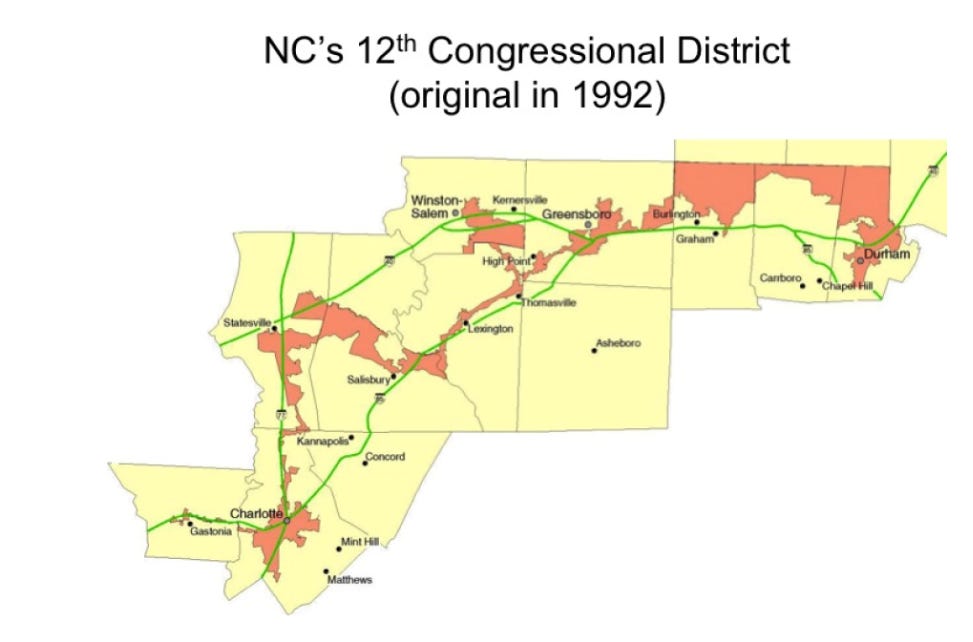
That map reached the Supreme Court in Shaw v. Reno (1993). The Court decided that racial gerrymandering could be challenged as a violation of the Equal Protection Clause of the Fourteenth Amendment. Two years later, in Miller v. Johnson (1995), the Court went further, holding that a district is unconstitutional when race is the predominant factor in drawing its lines unless the policy is narrowly tailored to achieve a compelling government interest. They wrote that the legislature had “subordinated traditional race-neutral districting principles, including but not limited to compactness, contiguity, and respect for political subdivisions or communities defined by actual shared interests, to racial considerations.”
The Constitution doesn’t ask whether a racial classification is well-intentioned; it only asks if the racial classification takes place. If it does, there are only a couple of reasons why it’s considered permissible (remedying specific, identified past discrimination by the government actor [not general, societal] and preventing racial riots in prison security). But even these decisions did not totally end the practice, and states continued to draw these gerrymandered maps, courts argued them, and the tension remained.
Then came the case in Louisiana.
What is Louisiana v. Callais?
After the 2020 census, Louisiana’s Republican-controlled legislature drew a congressional map giving the state five white-majority districts and only one Black-majority district. Black voters sued, arguing the map violated the Voting Rights Act by diluting their votes since they make up one-third of the state’s population. Under court order, the legislature redrew the map to add a second majority-Black district. A new group of plaintiffs then sued that map, arguing it was an unconstitutional racial gerrymander. The Supreme Court agreed, 6–3, striking it down.
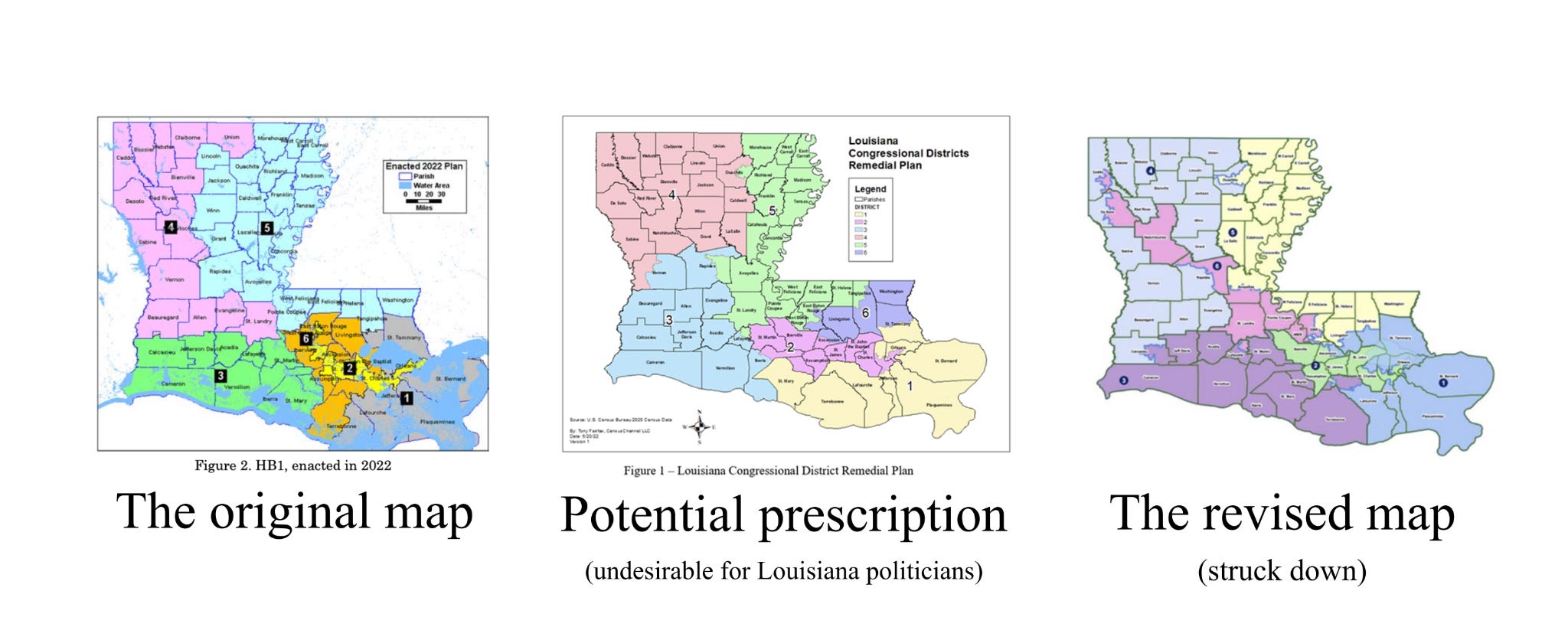
The Supreme Court used this case to clarify: the obligation to protect minority voting power under the Voting Rights Act doesn’t authorize states to make race the dominant organizing principle of a congressional map. That does not deliver a deadly blow to the Voting Rights Act, and it is a good thing for our country.
The remedy was always supposed to be drawing maps around communities. Louisiana v. Callais is a correction to the overcorrection, which has too often drawn them around race and called it a community.
Our communities are more than the color of our skin
Because of our nation’s history with race and the long and winding road we have taken to healing, race is often at the forefront of our minds when we think about identity. But each person’s identity and the political issues that matter to them are shaped by many facets of the community they come from. It is more complex than just their skin color.
To quote Miller and Shaw once again: when “the state assumes from a group of voters’ race that they ‘think alike, share the same political interests, and will prefer the same candidates at the polls,’ it engages in racial stereotyping at odds with equal protection mandates.” To suggest that the Black residents in the urban Baton Rouge and Lafayette community in the southcentral part of Louisiana have the exact same interests, influences, and concerns as the Black residents in the rural Shreveport community in the northwest part of the state, just because they are both Black ignores the forces outside of race that shape someone’s beliefs, identity, and the issues that matter to them.
Even when Black men and women make up the minority of a community, it does not mean that they belong to it any less than the racial majority. The dismay expressed by the belief that the Voting Rights Act is dead because there can no longer be racially gerrymandered districts ignores the many prominent Black men and women who have not been elected in majority black districts. In 2022, Wesley Hunt was elected to the House from Texas’s 38th district, which is majority white. “Trump would have won by over 20 points,” he said in a recent interview, “and I won [in 2022] by over 25 points.” He identifies with his district, and they identify with him.
Many more examples abound. Tim Scott’s district in South Carolina is around 75% white. Lisa Blunt Rochester, the first Black woman to represent Delaware in both the House and Senate, had to win a statewide election (in a state where Black people make up a minority). Raphael Warnock, the first Black senator for Georgia, also won a statewide election with a Black minority. Barack Obama won the presidency in 2008 with nearly 53% of the popular vote and 68% of the electoral votes, and Kamala Harris - despite losing the election - won just over 48% of the popular vote in 2024, while the Census reports Black people made up only 15.2% of the population that year. Both ran against white men.
A Black-majority district may once have been the only path for a Black man or woman to express their political will, but that is no longer the case. They now belong to and are supported by communities in which they are a minority. It is these community lines that should be respected in the districting process.
What about partisan gerrymandering?
In her dissent, Justice Kagan writes that minorities will now be “cracked out of the electoral process.” I am not arguing that it is a good thing. I’m arguing that the solution to the cracking of one, geographically compact minority community is not the packing of that community with other disparate Black communities that stretch across the state until there is enough to form a majority district.
There has to be a middle ground where we can respect natural community lines where they exist and draw maps that reflect them in reasonable ways, rather than devising every conceivable way to maximize party representation. But that decision isn’t with the Supreme Court: it’s with our elected representatives at the state and national level.
The role of the Supreme Court is to interpret the laws of our land and call attention to violations. So when the Court says something like “partisan gerrymandering claims are not justiciable in federal court,” it can feel like a punch to the gut. But what they are really saying is that there is nothing in the rules that currently forbids it. That doesn’t mean that will always be the case. In fact, the opinion makes this explicit:
“..the desirability of some of these criteria may be disputed. But because they are not forbidden by the Constitution, it is up to each State to decide what weight, if any, they warrant.”
It would be up to each State to decide not to enact these kinds of maps, or up to Congress to enact a law that prevents such abuse on a national level. Specifically, in Article 1, Section 4, the Elections Clause: “The times, Places and Manner of conducting elections shall be prescribed in each State by the Legislature thereof; but Congress may at any time by law make or alter such Regulations.”
So, for congressional maps, Congress has the authority to establish redistricting guidelines. For state-level districts, however, that would likely need to be left to the state houses. Still, if state houses deemed that kind of gerrymandering to be abusive, they could take necessary action to prevent it.
Illinois (where I live) has a Congressional map that does this very thing. According to the Supreme Court, there are no laws in place to forbid this kind of action. Racial gerrymandering and partisan gerrymandering are two different poisons from the same tree: using map-drawing to override the real complexities of a community.
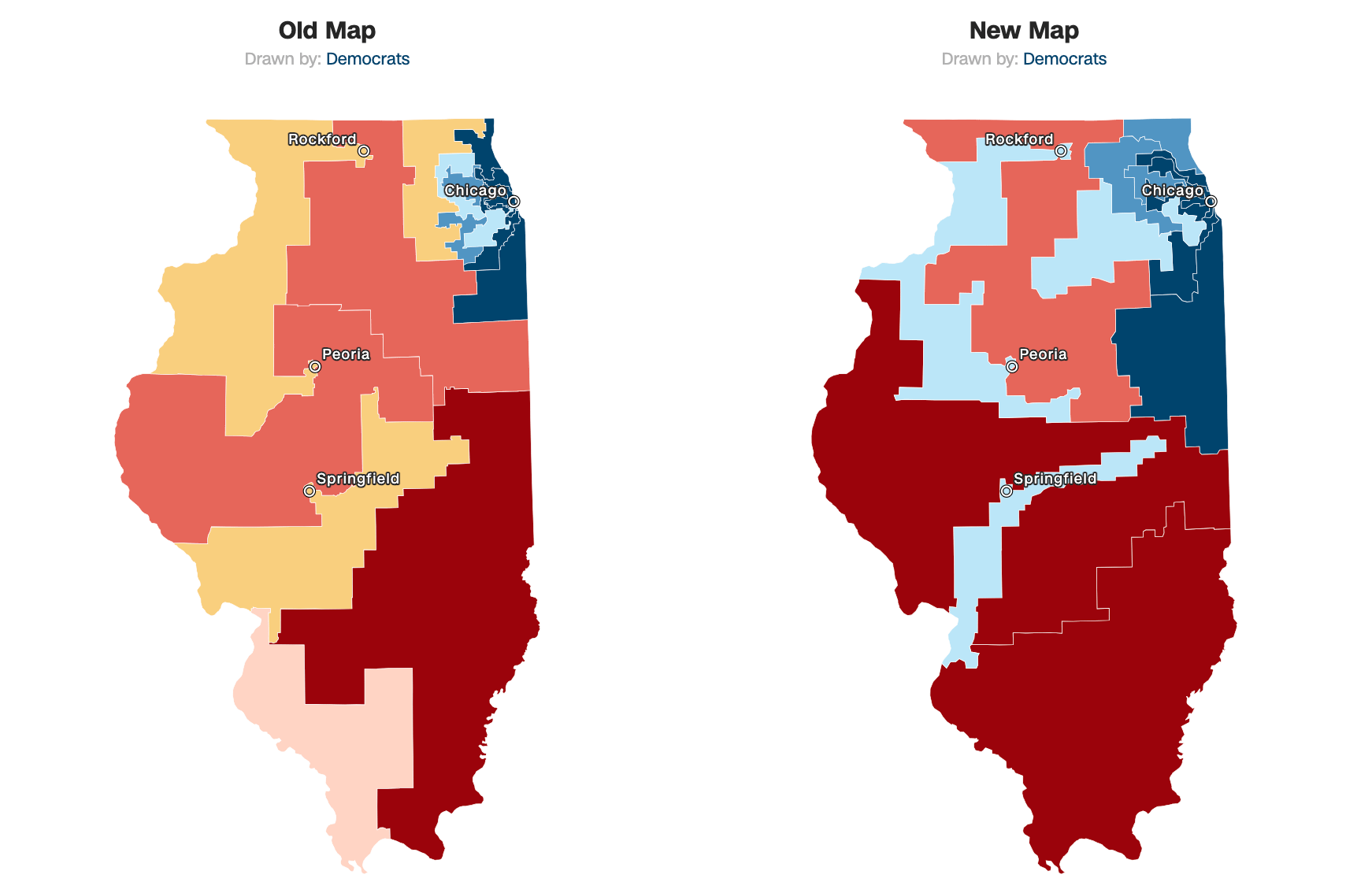
The problem we face in solving the partisan issue is a lack of political will. The party in charge of a state, or the one with the most seats in either chamber of Congress, will not pass a bill that limits its ability to manipulate how the will of the people is read. Their priority is to retain power and protect incumbents. If a party gets too greedy, their gerrymander can backfire on them, so there are some built-in limits based on math, but changing boundaries to create “safe seats” for certain officials is not in the spirit of democratic freedom and choice our nation is meant to embody. It will be up to each of us to convince enough of our elected officials to value geographic community over partisan gerrymandering. Only then can we make the changes necessary to improve our democratic processes.
What’s next?
We are just a couple of months away from celebrating our nation’s 250th anniversary. Louisiana v. Callais is cause for celebration, not mourning. We have made significant progress since the birth of our nation, since the slave plantations, since poll taxes and literacy tests, since a Black man or woman could only feel like they were represented in or get elected in a majority Black district. By further restricting intentional race-based treatment in the law, this court decision is part of that progress.
These celebrations are only possible because the men and women who came before us realized something we too should embrace: our democratic processes require refinement and continuous work. For 250 years, we have struggled to ensure things like racial animosity and partisan divisions do not tear our country apart. Each of us has a responsibility to continue that fight.
BRAVO:
The Democratic Party establishment and its political leaders are not interested in Justice. They are interested in the judicial system agreeing with them, no matter what. https://torrancestephensphd.substack.com/p/fighting-and-dying-for-segregation
Nobody serious thinks Callais literally repealed the VRA; the concern is that it makes vote-dilution claims much harder to prove. Saying Black candidates can win majority-white districts doesn’t answer whether compact Black communities are being cracked apart in Louisiana. That’s the main issue people see, and your article mostly sidesteps it.